
 EN
EN
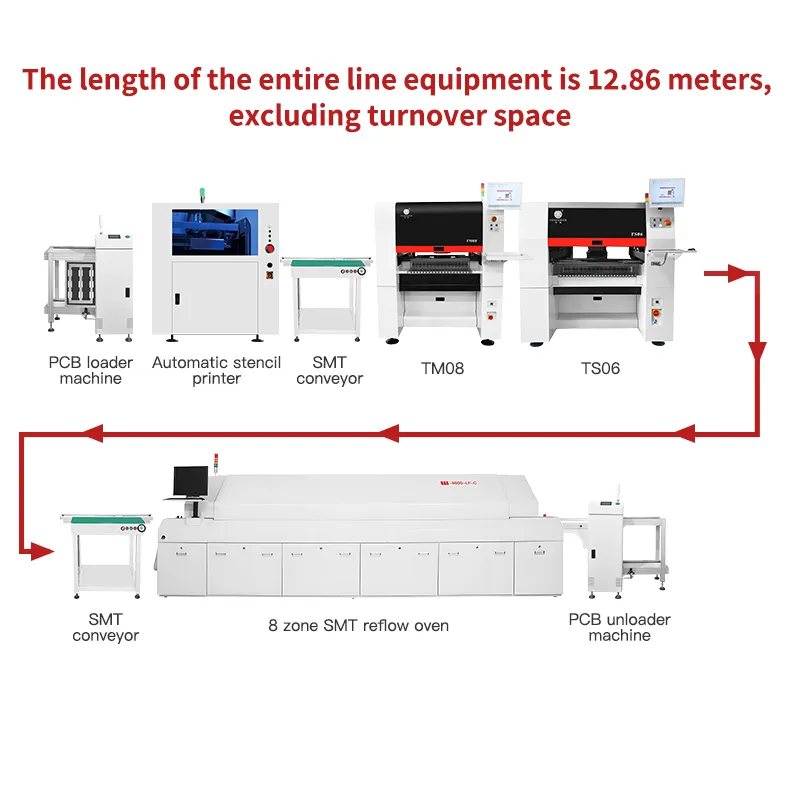
SMT Production Line: Definition, Core Components, and Systemic Role in Electronics Manufacturing
An SMT (Surface Mount Technology) production line is a fully integrated, automated system designed to mount electronic components directly onto printed circuit boards (PCBs). Unlike legacy through-hole assembly, this approach enables higher component density, faster production cycles exceeding 10,000 placements per hour, and support for miniaturized devices.
What constitutes an SMT production line: Integrated definition and functional scope
Surface Mount Technology production lines bring together several key steps including applying solder paste, placing components, soldering through heat, and inspecting finished boards all within one automated system. When everything works together this way, there's no need for people to handle the boards at different stages, which cuts down on defects significantly when compared with older semi-automated methods. Some estimates suggest defect rates drop around half or more. These systems are built for mass producing printed circuit boards but they can also switch between products pretty quickly. That makes them really valuable in industries where volume matters most like making smartphones, tablets, and various medical equipment where reliability is critical.
Key hardware components and their synchronized workflow roles
Each machine performs a specialized task with precision timing:
| Component | Primary Function | Impact on Workflow |
|---|---|---|
| Solder Paste Printer | Deposits solder paste onto PCB pads | Ensures precise solder volume (±0.01mm tolerance) |
| Pick-and-Place Machine | Positions components at 25,000+ CPH | Enables micron-level accuracy (0.025mm) |
| Reflow Oven | Melts solder paste via controlled heating zones | Creates permanent electrical connections |
| Automated Optical Inspection (AOI) | Scans for defects post-soldering | Reduces escape rate to <500 PPM |
This synchronization allows continuous board processing with near-zero human intervention, slashing labor costs by 40–70% while maintaining 99.95% placement accuracy.
The End-to-End SMT Process Flow and Its Efficiency Drivers
A modern SMT production line transforms raw PCBs into functional assemblies through six tightly synchronized stages: solder paste printing, component placement, reflow soldering, cleaning, automated optical inspection (AOI), and functional testing.
Six critical SMT process steps—from solder paste printing to functional testing
- Solder Paste Printing: Stencil alignment accuracy within ±15µm ensures consistent deposition
- High-Speed Placement: Vision-guided pick-and-place systems achieve 0.025mm precision
- Reflow Profiling: 9-zone ovens with nitrogen injection prevent oxidation during peak temperatures of 240°C
- Cleaning Systems: Aqueous or solvent-based removal of ionic contaminants below 1.56 µg/cm²
- Automated Inspection: SPI/AOI machines detect 99.7% of soldering defects per IPC-A-610 standards
- Boundary Scan Testing: Validates circuit functionality at 5× manual testing speed
How process control boosts first-pass yield and reduces rework
Real-time monitoring of solder paste viscosity, oven temperatures, and placement pressure enables immediate corrections before defects occur. Closed-loop systems feed SPI data directly to printers, reducing paste-related errors by 63%. As highlighted in a recent process optimization study, manufacturers implementing statistical process control (SPC) achieve:
| Metric | Improvement | Impact |
|---|---|---|
| First-pass yield | +34% | Fewer rework stations required |
| Material waste | -28% | Lower solder paste consumption |
| Throughput | +22% | Faster order fulfillment cycles |
This data-driven approach minimizes corrective actions, slashing rework costs by $740k annually per line (Ponemon 2023). By maintaining process parameters within 1.5σ limits, facilities consistently achieve defect rates below 500 ppm.
Measurable Efficiency Gains Enabled by the SMT Production Line
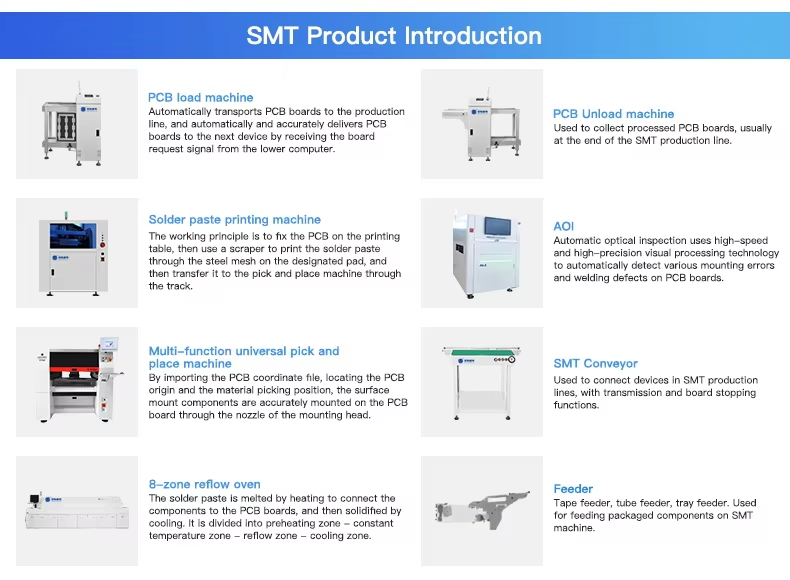
Cost reduction, throughput acceleration, and labor optimization
SMT production lines today offer real efficiency gains in several key areas. When companies automate their processes, they often see labor costs drop somewhere between 30 and 50 percent compared to manual work, plus fewer mistakes from humans getting tired or distracted. The high speed placement machines can crank out well over 25 thousand components every hour, and top manufacturers actually manage to keep defects under 100 per million units. For quality checks, most modern setups include SPI (solder paste inspection) and AOI (automated optical inspection) systems that spot problems before they become expensive repairs, cutting down on fixing costs by around 60%. Putting all these improvements together usually means businesses get their money back within about two years based on what we've seen across the industry.
Scalability across prototyping, mid-volume, and high-volume production
Modern SMT systems come with modular designs that work well whether someone is building prototypes or going into full scale manufacturing. The equipment has flexible feeders and tooling that can be swapped out quickly, so switching between different products doesn't mean long setup times. For smaller batches, these systems start making sense economically around 500 pieces. When companies need bigger volumes, they can crank output past a million circuit boards each month. The whole system relies on data monitoring to keep quality steady no matter what volume level they're operating at. This matters a lot for electronic component makers who deal with market ups and downs all the time.
Optimizing Your SMT Production Line for Long-Term Competitive Advantage
When it comes to getting ahead in manufacturing, smart optimization strategies give companies that edge they need to stay competitive over the long haul. Let's start with lean manufacturing techniques. These methods cut down on wasted materials and those frustrating periods when machines just sit idle. Companies report savings of around 18% per year on operating expenses while their production speed picks up noticeably. Next up are those real time monitoring systems powered by artificial intelligence. Factories using them see about a third fewer defects in their products and can predict equipment failures before they happen, which saves money and headaches from unexpected shutdowns. Sustainability matters too. Switching to machines that consume less power and adopting processes like lead free soldering not only helps protect the environment but also brings down electricity bills by somewhere between 15 and 20 percent. The real magic happens when all these improvements work together. Better control means more good products on the first try, plants can handle changing customer demands without expensive retooling, and automatic data gathering keeps things improving constantly. Look at the numbers: manufacturers who focus on these areas typically boost their productivity by roughly 22% and get their return on investment for new tech about 40% quicker than factories that haven't made these optimizations.
FAQ
What is an SMT production line?
An SMT production line is an automated system designed to mount electronic components onto PCBs, characterized by higher component density and faster production cycles.
What are the primary components of an SMT production line?
The primary components include a solder paste printer, pick-and-place machine, reflow oven, and automated optical inspection systems.
How does process control improve yields in SMT lines?
Process control allows real-time monitoring and immediate corrections, significantly boosting first-pass yields and reducing rework costs.
Why is scalability important in SMT production lines?
Scalability is important as it allows flexible production from prototyping to high-volume manufacturing, adapting quickly to market demands.