
 EN
EN
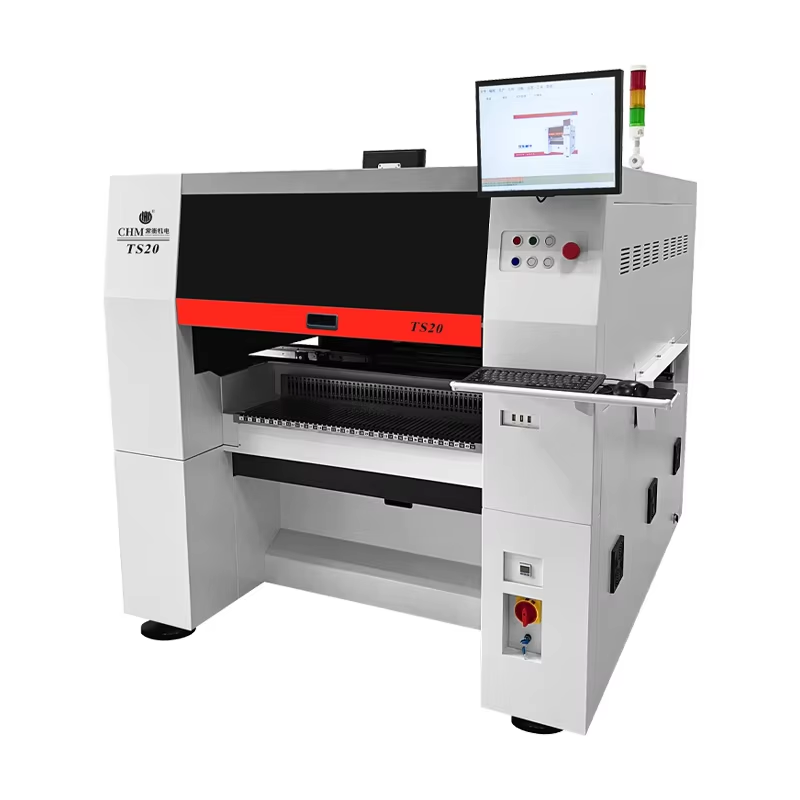
Match Speed, Accuracy, and Flexibility to Your PCB Assembly Profile
Evaluating CPH, placement accuracy (±µm), and changeover agility for your product mix
When selecting an SMT pick and place machine, prioritize three interlinked metrics:
- CPH (Components Per Hour): Align with your annual production volume. High-volume runs (100k boards/year) often demand 30k+ CPH.
- Placement accuracy (±25–50µm): Critical for micro-components like 01005 resistors or 0.4mm-pitch QFNs. Systems achieving ±40µm or better reduce rework by ≈30% (Industry Benchmark 2023).
- Changeover agility: Measured by feeder-swap time and recipe programming speed. For mixed-product lines, modular feeders cut setup time by 60% versus fixed systems.
| Machine Type | Speed (CPH) | Accuracy (±µm) | Changeover Time | Ideal Use Case |
|---|---|---|---|---|
| Chip Shooter | 50,000 | 50–100 | High | Low-mix, high-volume |
| Flexible Placer | 10,000–30,000 | 20–40 | Low | High-mix, low-volume |
| Hybrid Modular | Scalable | Adjustable | Medium | Evolving production needs |
Top manufacturers enhance agility using automated feeder racks and vision-assisted calibration—enabling rapid transitions between PCB designs without compromising throughput.
Aligning throughput with UPH targets—and why high-mix, low-volume production demands flexibility over raw speed
For high-mix, low-volume (HMLV) assembly, UPH (Units Per Hour) rarely depends on maximum CPH. Instead:
- Prioritize machines with <10-minute changeovers to handle frequent product rotations.
- Opt for dual-lane conveyors or modular heads—enabling simultaneous small-batch processing.
- Balance speed with precision: A 20k CPH machine with ±30µm accuracy outperforms a 50k CPH system requiring post-placement corrections.
HMLV specialists report 15–20% higher equipment utilization rates using reconfigurable systems versus dedicated high-speed lines (Assembly Analytics 2023). This agility reduces idle time when switching between prototypes, legacy boards, and new designs—key for ROI in dynamic electronics markets.
Assess Technical Capabilities Against Component and PCB Complexity
Vision system resolution and fine-pitch support: Handling 0.4mm-pitch QFNs, 01005s, and 2mm BGAs reliably
Modern PCB assembly demands vision systems capable of micron-level precision. For components like 0.4mm-pitch quad flat no-leads (QFNs), 01005 chips (0.4×0.2mm), or 2mm ball grid arrays (BGAs), placement accuracy below ±15µm is non-negotiable. High-resolution cameras (≥25µm/pixel) paired with laser alignment ensure reliable recognition of microscopic leads and solder balls. Systems lacking this capability risk misalignment, solder bridging, or tombstoning—defects costing over $740k annually in rework (Ponemon 2023).
Component size range and feeder architecture: Chip shooter vs. flexible head trade-offs for SMT equipment manufacturer compatibility
Component diversity directly influences feeder selection:
| Feeder Type | Ideal Component Range | Changeover Speed | Best For |
|---|---|---|---|
| Chip Shooter | 0402–1206 passives | <15 seconds | High-volume single-board |
| Flexible Head | 01005–70mm connectors | <5 minutes | High-mix prototypes |
Chip shooters excel in rapid placement of standardized parts but struggle with odd-form components. Flexible heads accommodate larger ICs and connectors while maintaining precision—but sacrifice raw speed. When selecting an SMT pick and place machine, prioritize feeder compatibility with your primary SMT equipment manufacturer to avoid proprietary lock-in. Leading manufacturers now offer hybrid systems blending both architectures—critical for scaling production without bottlenecking changeovers.
Prioritize Scalability, Modularity, and Future-Proofing in Your Pick and Place Machine Selection
Selecting an SMT pick and place machine demands foresight beyond immediate needs. Scalability ensures your equipment grows with production volumes—modular designs allow adding feeders or upgrading vision systems without replacing entire units. Future-proofing mitigates obsolescence risks; prioritize machines with firmware update paths and compatibility with emerging component packages (e.g., 0.3mm-pitch ICs). Manufacturers emphasizing open architecture enable third-party tool integration, extending machine lifespan. Consider Mean Time Between Failures (MTBF) exceeding 10,000 hours and modular component trays that reduce changeover time by 40% in high-mix environments. This strategic approach minimizes long-term downtime and avoids costly reinvestments when scaling PCB assembly lines.
Evaluate Total Cost of Ownership and Vendor Support for Long-Term PCB Assembly Machine Reliability
Beyond upfront cost: Service contracts, spare parts availability, and software update policies from SMT equipment manufacturers
When selecting an SMT pick and place machine, the purchase price represents just 30–40% of your long-term expenses. Maintenance typically constitutes 50–70% of TCO for industrial equipment (WISS analysis). Routine upkeep like nozzle replacements and rail calibration quickly accumulates—especially with high-uptime production lines. Reputable vendors provide transparent service contracts covering:
- Critical spare parts inventories (feeders, motors)
- Software updates ensuring compatibility with new components
- Remote diagnostics reducing machine downtime
You’ll face 20–30% higher lifecycle costs without guaranteed same-day technical support or version-locked firmware. Always verify vendor response SLAs and update policies before finalizing your PCB assembly machine investment.
FAQs
What factors should I consider when selecting an SMT pick and place machine?
Key factors include throughput (CPH), placement accuracy, changeover agility, scalability, and vendor support. Additionally, consider compatibility with your production mix and component diversity.
What does CPH stand for, and why is it important?
CPH stands for Components Per Hour, indicating the speed of placement. It’s important for aligning machine capacity with annual production volume, especially for high-volume runs.
How does placement accuracy affect production quality?
Placement accuracy (measured in ±µm) is critical for handling micro-components and reducing defects like misalignment and solder bridging. Higher accuracy reduces costly rework.
Why is changeover agility significant in high-mix production?
Changeover agility minimizes setup time between product rotations. Modular systems, automated feeders, and recipe programming reduce downtime and boost productivity in dynamic assembly environments.
What is the benefit of modular systems in PCB assembly?
Modular systems allow scalability and upgrading individual components, like feeders or vision systems. They future-proof production lines while reducing long-term reinvestments.
Table of Contents
- Match Speed, Accuracy, and Flexibility to Your PCB Assembly Profile
- Assess Technical Capabilities Against Component and PCB Complexity
- Prioritize Scalability, Modularity, and Future-Proofing in Your Pick and Place Machine Selection
- Evaluate Total Cost of Ownership and Vendor Support for Long-Term PCB Assembly Machine Reliability
- FAQs