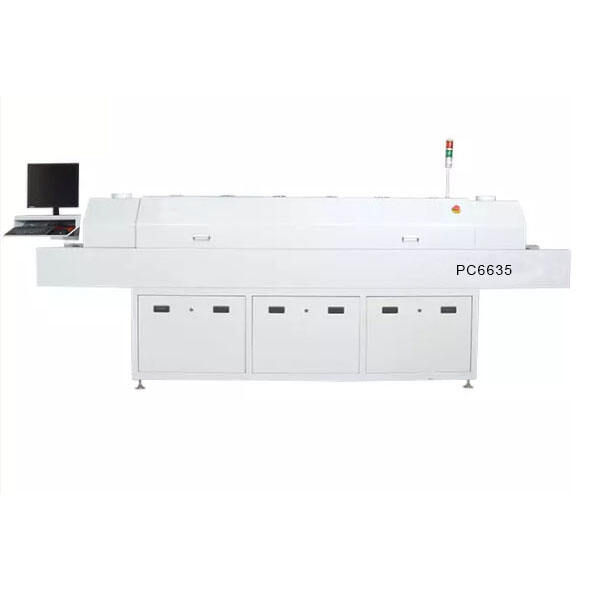
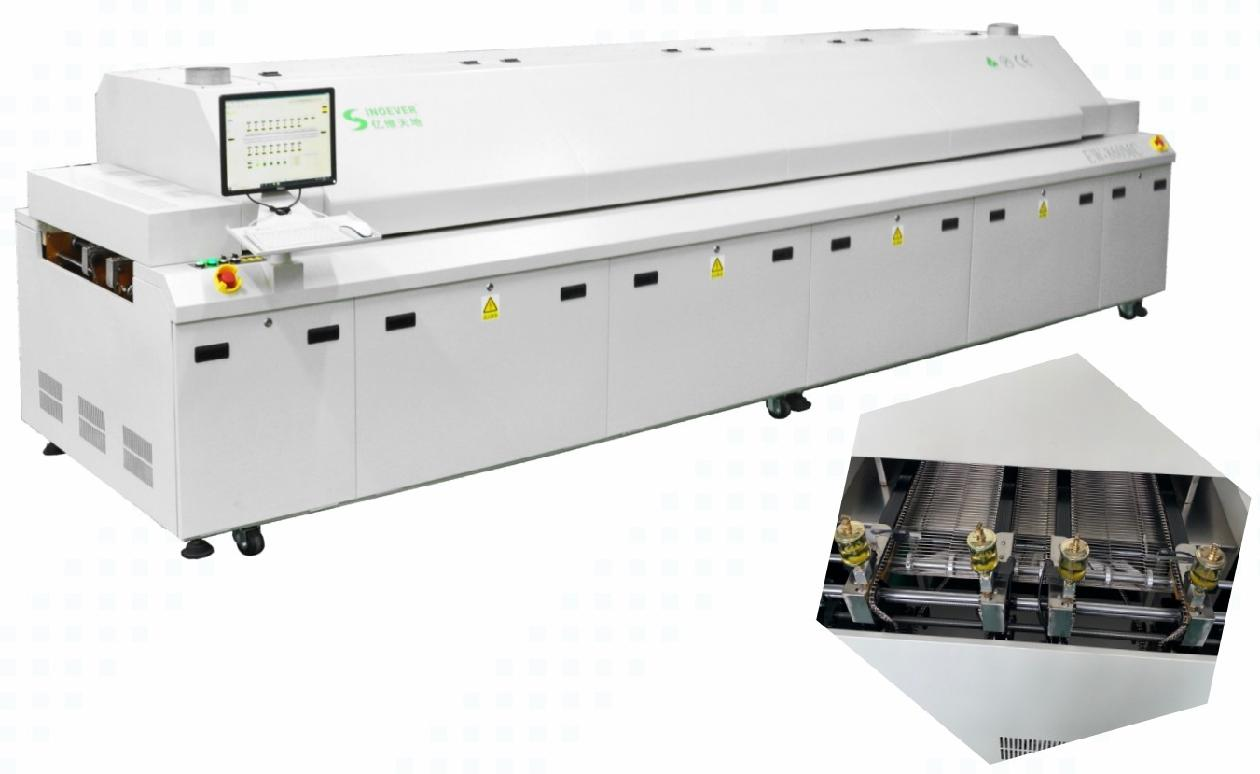
The Future of Surface Mount Reflow Ovens: Powering the Future of Electronics Manufacturing
The surface mount reflow oven market is expected to reach $2.1 billion by 2030, driven by explosive demand for compact, high-performance electronics across a wide range of industries.1 As PCB designs evolve - with thinner substrates (0.2-0.4 mm), higher component densities (01005 packages), and lead-free soldering (SAC305) - precise thermal management becomes critical. Here's how the new generation of reflow ovens is opening up new areas of application:
1. Consumer electronics - miniaturization and high-speed production
Trends:
Ultra-thin flexible PCB (0.2mm) for foldable smartphones/wearables
High Density Interconnect (HDI) with 0201/01005 components
Lead-free reflow requiring ±2°C thermal uniformity
Reflow innovations for growth:
✔ Micro-nozzle convection heating prevents flex circuit warpage 6
✔ Artificial intelligence-driven thermal profiling adapts to mixed-technology boards (SMD+THT)
✔ Fast ramp cooling (6°C/sec) reduces stress on micro-BGAs 4
Emerging Applications:
AR/VR headsets
Ultra-thin IoT sensors
Foldable display components
2. Automotive electronics - reliability under extreme conditions
Critical Requirements:
ADAS/ECU modules compliant with AEC-Q100 standard
Void-free soldering of Lidar/Radar PCBs (<5 voids in BGA solder joints)
Mixed technology (SMD + through-hole) assembly
Reflow breakthrough:
✔ Nitrogen-assisted soldering minimizes oxidation in high-reliability solder joints 4
✔ Pin-in-paste (PiP) technology eliminates wave soldering on hybrid boards 3
✔ Automotive-grade contouring with 10-zone accuracy (IPC-7530 compliant) 1
Future Applications:
Self-driving car computing modules
Solid-state battery management systems
5G-V2X communication boards
3. Medical devices - zero-defect manufacturing of life-critical systems
Strict Requirements:
Sealing of implantable devices (ISO 13485)
Biocompatible solder (gold-coated tin-silver-copper)
Full traceability for FDA audits
Reflow Soldering Advancements:
✔ Closed-loop thermal control (±1°C) for void-free medical BGAs 6
✔ X-ray verified profiles to ensure <8% void in pacemaker PCBs
✔ IoT-enabled data logging for real-time process validation 1
Next-generation applications:
Neural interface devices
Disposable diagnostic consumables
Robotic surgical instruments
16
May
23
Jun
23
Jun
23
Jun
Hunan Charmhigh provides top-notch SMT pick and place machines for electronics manufacturing. Our R&D-driven solutions and certifications ensure excellence. Contact us today!
No. 392, Minghu Road, Xiangjiang New Area, Changsha City, Hunan Province, China
Copyright © Hunan Charmhigh Electromechanical Equipment Co., Ltd. Privacy Policy
 EN
EN