
 EN
EN
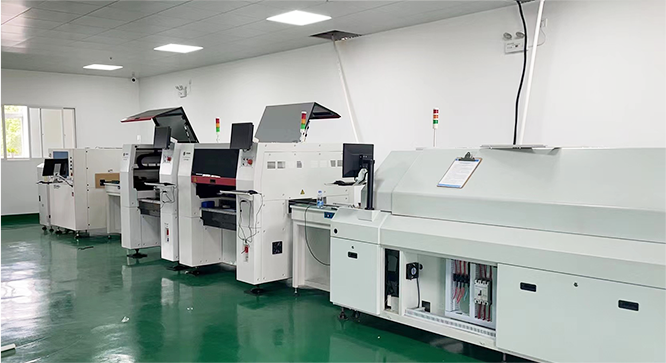
SMT Machine Accuracy: Why Placement Precision Determines Yield for Fine-Pitch PCBs
How ±15–±125 µm Placement Accuracy Directly Impacts Defect Rates in 0201 and 01005 Assembly
Modern SMT pick and place machines require placement accuracy within ±25 µm to reliably assemble 0201 (0.6mm × 0.3mm) and 01005 (0.4mm × 0.2mm) components. At ±50 µm deviation—common in mid-tier equipment—defect rates surge by 18–22% due to solder bridging and non-wetting, as pad tolerances shrink below 100 µm. For 01005 assembly, each additional 10 µm beyond ±25 µm increases tombstoning risk by 7%, per the Industry Standard Placement Deviation Formula. Precision becomes critical when terminal gaps narrow to 0.15mm: even 15 µm misalignment can cause electrical opens. Leading manufacturers address this with real-time laser profilometry to verify component coplanarity during placement.
Repeatability Over Peak Spec: The Critical Role of Vision System Calibration and Real-World Stability
Advertised “peak” accuracy specs often ignore thermal drift, vibration, and production-load variability. Machines maintaining ±30 µm repeatability over an 8-hour run achieve 40% higher first-pass yields than those fluctuating to ±75 µm under load. This stability depends on three integrated capabilities:
- Closed-loop vision systems that recalibrate nozzle offsets every 500 placements
- Thermal compensation algorithms neutralizing frame expansion at speeds above 30,000 CPH
- Adaptive motion controls that reduce high-speed placement errors by 40%
Without them, calibration drift can degrade accuracy by 1.5 µm/hour—turning a ±25 µm machine into a ±60 µm liability after one shift. Vendors validating long-term repeatability with IPC-9852 test reports provide the strongest evidence of real-world performance.
SMT Machine Speed: Matching Real-World Throughput (CPH) to Your Production Profile
Understanding de-rating: Why advertised CPH drops 30–50% with mixed components, fine pitch, or panelized boards
Manufacturers’ Components Per Hour (CPH) ratings reflect ideal conditions—single-component types on standardized boards with perfect feed alignment. In practice, throughput drops 30–50% due to fine-pitch placement demands, mixed component sizes requiring frequent nozzle changes, and panelized board handling. A machine rated at 50,000 CPH may deliver only 35,000 CPH when placing 0201 capacitors alongside QFNs—a gap that directly erodes ROI through hidden bottlenecks.
Beyond board/hour: Aligning cycle time with your average component count, feeder changes, and changeover frequency
True throughput optimization requires matching machine capability to your operational rhythm—not catalog specs. High-component-density boards increase placement cycles; low-density designs underutilize capacity. Frequent feeder swaps for high-mix assemblies add 15–30% downtime, while product changeovers can consume 20+ minutes per shift. A system claiming 70,000 CPH may sustain only 45,000 CPH across eight daily changeovers. Prioritize quick-change feeders (<90 seconds), automated calibration, and adaptive scheduling logic to minimize dead time—and align CPH targets to your actual component mix and change frequency.
Feeder Flexibility and Substrate Compatibility: Supporting High-Mix, Miniaturized, and Odd-Form Production
Your SMT machine’s feeder ecosystem defines its adaptability to evolving production needs. Reconfigurable feeding—supporting tape, stick, tray, and bulk formats—is essential for rapid swaps in high-mix environments. Flexible feeders accommodate part dimensions ranging from 01005 chips to large connectors without retooling delays.
Substrate handling is equally decisive. Verify compatibility with thin, flexible PCBs (≤0.4mm), rigid boards up to 5mm thick, and stage adjustability for odd-form geometries like heatsinks or irregular modules. Machines lacking this versatility struggle with specialized assemblies common in medical or aerospace manufacturing.
A 2025 client case study demonstrated a 76% reduction in changeover time after adopting modular feeder banks and substrate adapters from a leading industrial automation provider—converting low-volume prototype runs into profitable batch production.
SMT Machine Aftersales Service: The Hidden Driver of Uptime, ROI, and Long-Term Reliability
Regional service coverage, MTTR, and technician certification—why they outweigh initial price and specs
When selecting an SMT pick and place machine, aftersales support is the most consequential factor for uptime, yield consistency, and long-term ROI. Unplanned downtime costs electronics manufacturers over $740k annually in lost revenue (Ponemon Institute, 2023). Regional service coverage ensures certified technicians reach your facility within hours—not days—while rigorous certification guarantees accurate diagnostics and repairs. This combination reduces Mean Time to Repair (MTTR) by up to 65% compared to basic support contracts. Unlike static machine specifications, responsive, expert service actively sustains throughput by preventing multi-day stoppages from component-level failures. Ultimately, comprehensive aftersales support transforms your SMT investment from a capital expense into a resilient production asset—maintaining yield integrity across its full 8–10 year lifecycle.
Frequently Asked Questions (FAQs)
What is the importance of SMT placement accuracy?
SMT placement accuracy ensures proper alignment of components, reducing defects like solder bridging, electrical opens, and tombstoning during PCB assembly, especially for fine-pitch components.
How does real-world throughput differ from advertised CPH ratings?
Real-world throughput often drops 30–50% due to factors like mixed component sizes, frequent feeder changes, fine-pitch demands, and panelized board handling.
Why is feeder flexibility essential for SMT machines?
Feeder flexibility allows SMT machines to adapt to various component dimensions and formats, enabling rapid reconfiguration and reducing production delays in high-mix environments.
How does aftersales service impact SMT machine performance?
Comprehensive aftersales service improves uptime, ensures yield consistency, and minimizes repair times, directly sustaining production reliability and long-term ROI.
Table of Contents
- SMT Machine Accuracy: Why Placement Precision Determines Yield for Fine-Pitch PCBs
- SMT Machine Speed: Matching Real-World Throughput (CPH) to Your Production Profile
- Feeder Flexibility and Substrate Compatibility: Supporting High-Mix, Miniaturized, and Odd-Form Production
- SMT Machine Aftersales Service: The Hidden Driver of Uptime, ROI, and Long-Term Reliability
- Frequently Asked Questions (FAQs)